Role: UX Advocate & Research Lead
Responsible for conducting primary research, facilitating design thinking workshops, developing the PM-UX framework, and leading the pilot program implementation across John Deere’s product management teams.
Problem Statement
“How might we equip Product Managers with UX frameworks and collaborative workflows so they can confidently lead user-centered design and reduce reliance on ad-hoc practices?”
Pain Points Identified:
No centralized PM community or forums for sharing best practices.
Limited UX literacy: PMs struggle to interpret user research outputs and translate them into actionable requirements.
Technical background barriers: Non‑technical PMs face difficulty collaborating with engineers on data analysis and feasibility.
Undefined career pathways in PM & UX intersection.
Lack of tools & repositories for benchmarking and design guidelines.
User Needs & Business Requirements:
• Primary Users: Mid-level to senior Product Managers across John Deere’s diverse product lines
• Business KPIs: Reduce time-to-specification, improve cross-functional collaboration, increase PM confidence in UX decision-making
• Technical Constraints: Solution needed to integrate with existing John Deere workflows and tools (Jira, planning systems)
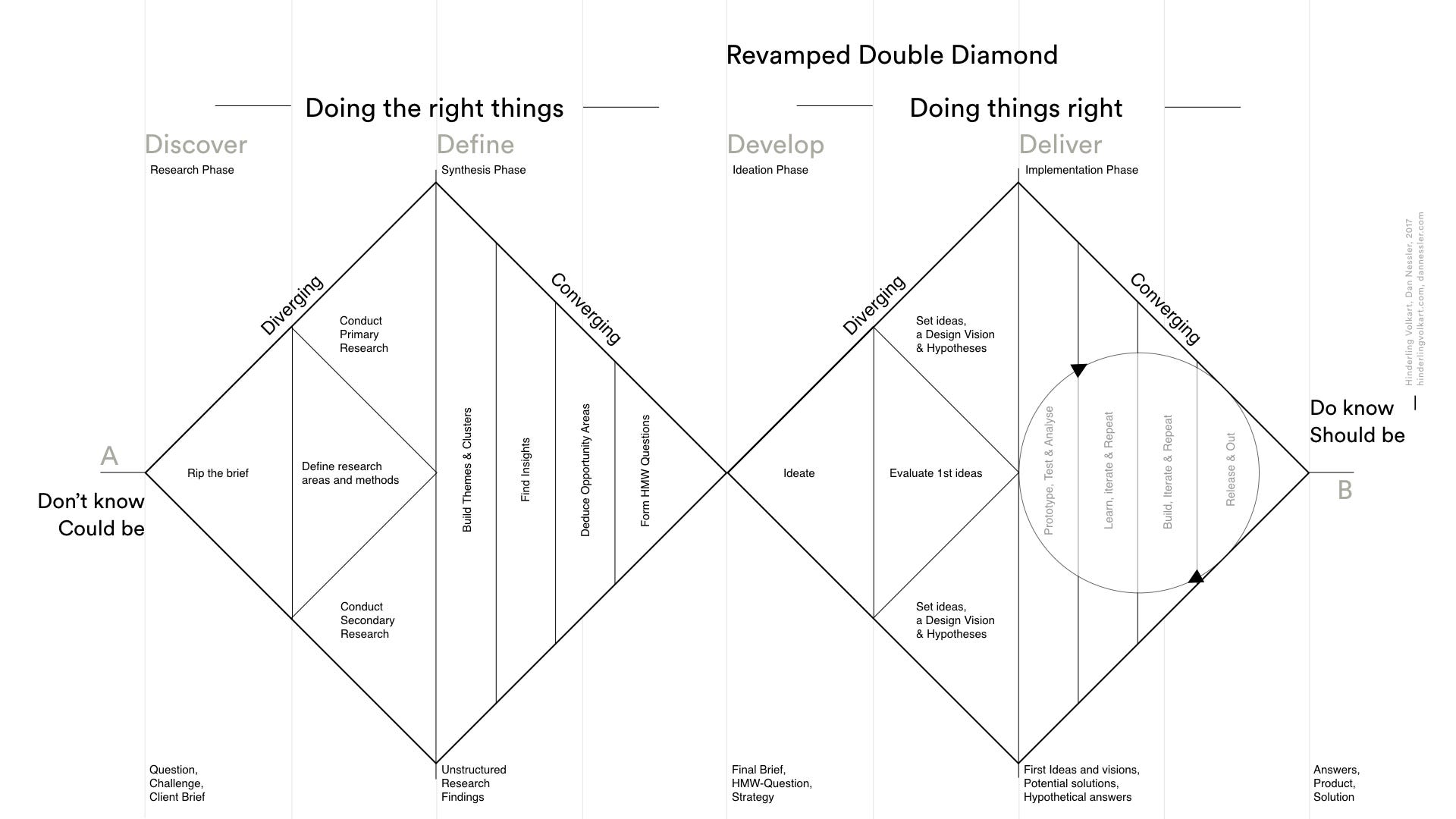
Methodology: Double Diamond + Design Thinking Workshops
Applied the Double Diamond framework (Discover, Define, Develop, Deliver) augmented by contextual interviews and collaborative design thinking sessions.
Discover (Diverge)
Contextual Interviews: Conducted 15 one‑on‑one sessions with PMs (mid‑level to senior) in situ—shadowing planning meetings, backlog refinement, and stakeholder syncs.
Stakeholder Mapping: Identified core user groups (PMs), allied roles (UX researchers, engineers), and sponsors (product leadership).
Affinity Mapping: Synthesized interview notes into clusters: UX challenges, career concerns, tool gaps.
Define (Converge)
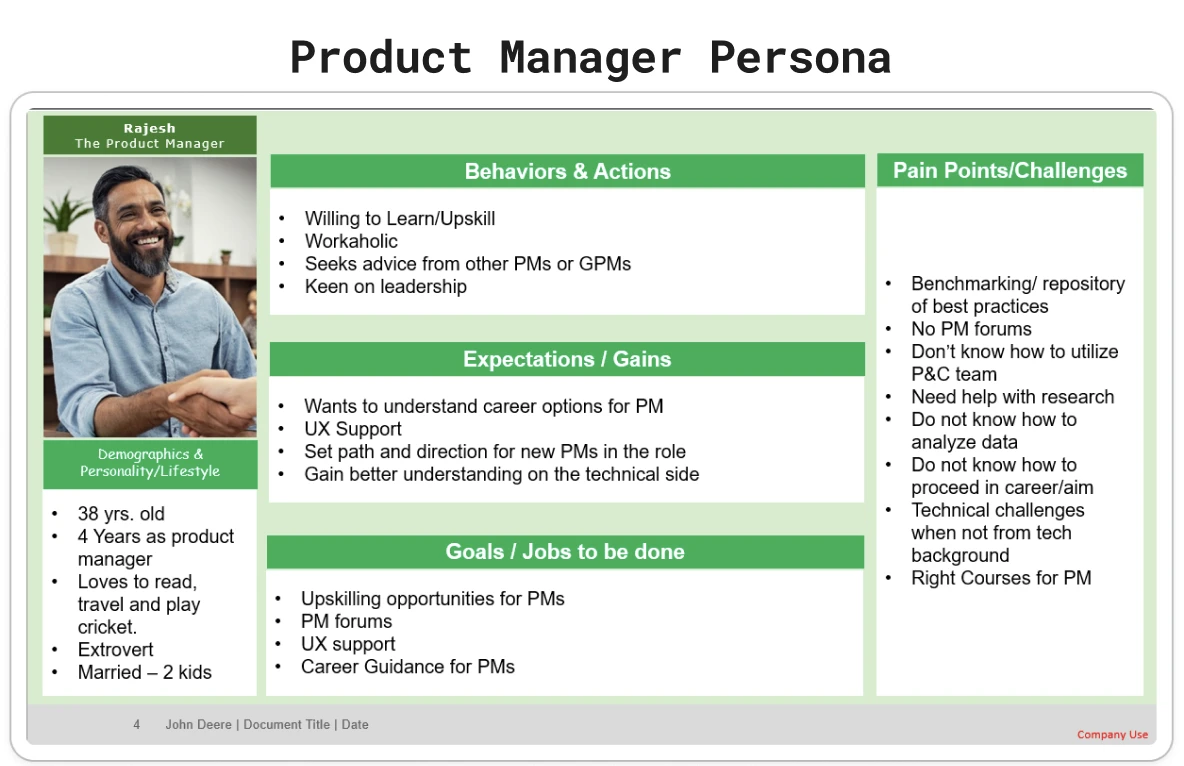
Persona Creation: Developed “Rajesh, the Product Manager” persona to capture demographics, behaviors, expectations, and pain points.
Problem Statement: “How might we equip PMs with UX frameworks and collaborative workflows so they can confidently lead user‑centered design and reduce reliance on ad‑hoc practices?”
Experience Map: Mapped Rajesh’s end‑to‑end journey from scoping a feature to launch—highlighting friction at user‑research handoff, design critique, and iteration.
Develop (Diverge)
Ideation Workshops: Ran two 2‑hour co‑creation sessions with PMs and UX leads using Crazy 8s and storyboarding to generate solutions:
PM‑UX Playbook with templates (journey maps, usability heuristics).
Buddy‑Up Program pairing PMs with UX mentors.
Community Forum for sharing case studies and best practices.
Micro‑learning Modules on core UX concepts (personas, wireframing, testing).
Prototyping: Created low‑fidelity wireframes of a dedicated “Product & UX Hub” portal integrating tutorials, templates, and discussion threads.
Deliver (Converge)
Usability Testing: Validated prototypes in 5 PMs’ monthly planning workshops; collected SUS scores and qualitative feedback.
Iterative Refinement: Simplified navigation, added contextual tips (“when to run a usability test”), and integrated Slack notifications for new content.
Pilot Launch: Rolled out the MVP portal to a 50‑person PM cohort, tracked engagement metrics (template downloads, forum posts) over 4 weeks.
Outcomes & Impact (Results)
UX Literacy Increase: 80% of pilot participants self‑reported greater confidence dissecting user‑research deliverables.
Process Efficiency: Average time to specification completion dropped by 25%, thanks to readily available templates.
Community Engagement: 120 forum threads started; 300+ replies within first month.
Cross‑Functional Collaboration: Engineers reported fewer clarifications needed on UX hypotheses, accelerating sprint cycles.
Key Learnings
Embedded Learning beats standalone training: PMs prefer micro‑lessons integrated into their workflows.
Community drives adoption: Peer‑to‑peer sharing solidified new practices more than top‑down mandates.
Iterate early & often: Usability tests with real PM workflows uncovered critical edge cases (e.g., mobile vs. desktop planning needs).
5. Next Steps
Scale & Personalize: Introduce role‑based tracks (e.g., data‑driven PMs vs. platform PMs).
Measure ROI: Improved UX outcomes to business metrics (conversion lift, support tickets).
Extend to Product Ops: Fold in analytics playbooks and A/B testing frameworks.